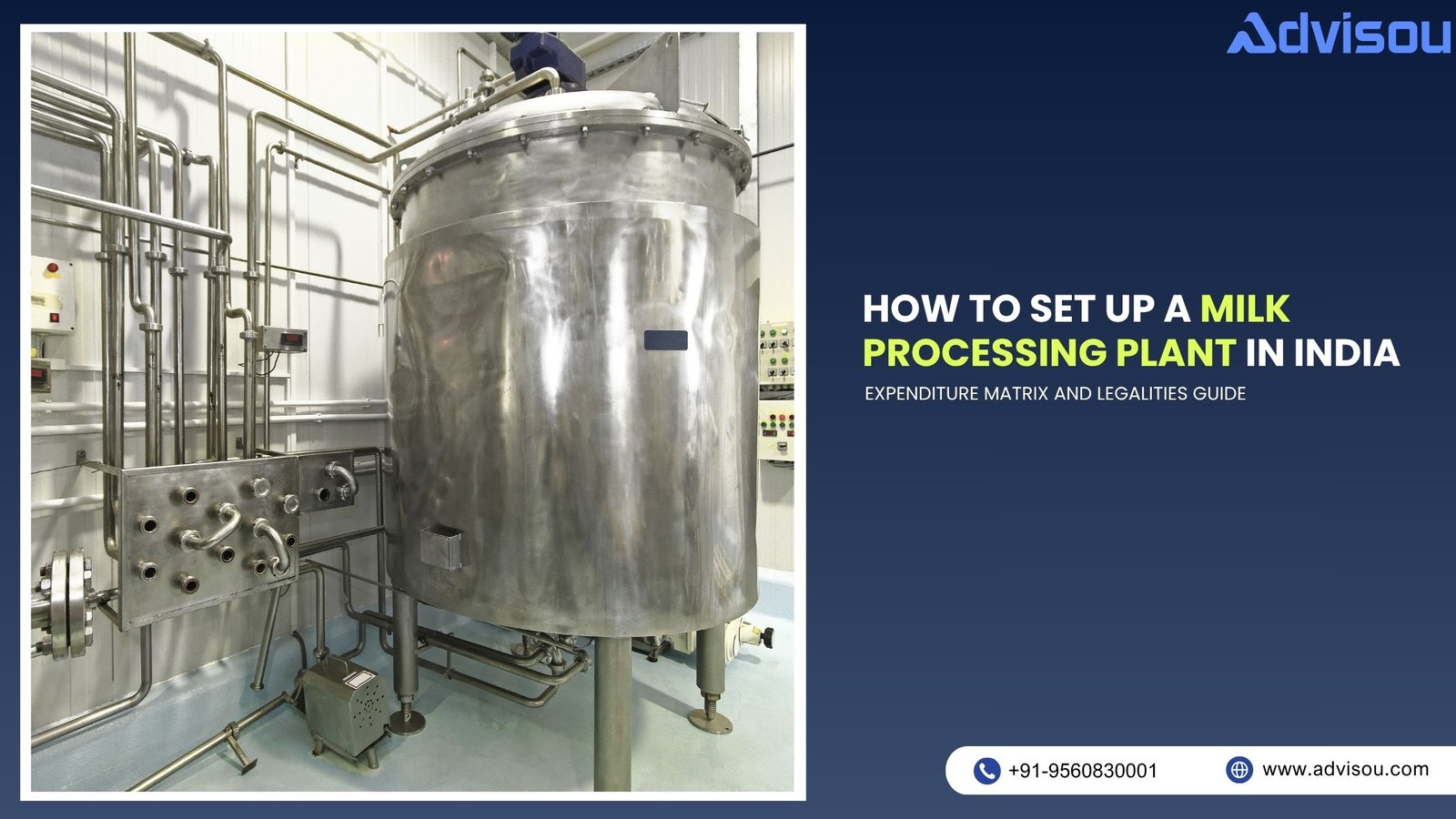
India’s dairy production has continued to achieve new benchmarks. The Indian dairy market accounts for 24% of worldwide milk output. It means setting up a milk processing plant isn’t just lucrative; it presents a long-term growth opportunity for startups. However, turning a dairy plant into a full-fledged production facility require significant cost and a suite of legal permits. If you are committed to kickstarting this venture or searching for an ideal sector, this blog has your back. So, let’s get started to know everything about a milk processing plant in 2026 and how you can set it up seamlessly.
Table of Contents
ToggleExpenditure Matrix for Milk Processing Plant
The production volume, product category, and choice of machinery will define the capital required to start such a business. Depending on these factors, the milk processing machine price can vary significantly. The table below will give a clear idea about what we mean:
| Plant Operational Scale | Approx. Capital Cost Range (INR) | Core Machinery Compositions | Primary Target Market |
| 500 Liters / Day | 8 Lakhs – 15 Lakhs | Batch Pasteurizer, Chiller, Manual Packager | Hyper-local, Direct-to-Consumer |
| 1,000 Liters / Day | 18 Lakhs – 28 Lakhs | HTST Mini-System, Cream Separator, Pouch Filler | Boutique Brands, Local Talukas |
| 5,000 Liters / Day | 55 Lakhs – 85 Lakhs | Continuous Pasteurizer, Homogenizer, Storage Silos | District-wide Distribution Networks |
| 10,000 Liters / Day | 1.2 Crores – 2.2 Crores | Full Automation, CIP Systems, Secondary Product Lines | Regional Dairy Brands & PSUs |
| 100,000+ Liters / Day | 15 Crores – 35 Crores+ | SCADA Control, Industrial Spray Dryers, Automated Silos | State/National Logistics, B2G Contracts |
Navigating Legalities for a Milk Processing Plant
While financing and resource arrangement are essential, regulatory compliance is something you can’t ignore. Since dairy products have a limited shelf life and can drastically impact customers, dairy companies are constantly monitored for health, hygiene, and environmental compliance. Long story short. It is a compliance-laden business. That said, here is exactly what you need to launch a milk processing plant.
- A milk processing plant must be a legally recognized entity, such as a partnership, LLP, OPC, or a private limited company.
- The dairy sector is highly competitive. Therefore, you should protect your brand via a trademark registration under Class 29. This will keep infringers at bay.
- Get the trade license to stay aligned with local health, safety, and spatial planning bylaws.
- Every dairy plant has some impact on the environment, and to keep the ill effects under control, it must install an Effluent Treatment Plant (ETP). Additionally, the plant must apply for Pollution NOC (Consent to Establish – CTE, followed by Consent to Operate – CTO) from their respective State Pollution Control Board (SPCB).
- If you have a pasteurization boiler in place, getting a valid air and water consent clearance is mandatory.
- Dairy products can easily be adulterated for profit. That’s where the food license comes in. Governed by the Food Safety and Standards Authority of India (FSSAI), the food license is available as a state and central license. Your production volume, revenue, and operational footprint will define which license you need.
- Mandatorily secure the BIS Certification and the ISI Mark if your plant intends to utilize a milk powder manufacturing plant cost model to produce Skimmed Milk Powder (IS 13334) or Infant Formula (IS 14433).
- While not mandatory, an MSME Udyam Registration can open doors to hassle-free finance important to keep your production rolling day in and day out.
- If you want to scale across government domains, the Government e-Marketplace (GeM) registration can be your legal ticket. With GeM registration, you can apply for lucrative supply contracts with state defense academies, government hospitals, public school mid-day meal programs, and public sector undertaking (PSU) cafeterias.
Operational Roadmap to Milk Processing Plant
To avoid bleeding capital while waiting for regulatory approvals, smart promoters follow a strictly coordinated deployment timeline. The roadmap below illustrates how machinery layout and regulatory engineering must run in parallel to ensure a legally compliant, on-time launch.
Phase 1: Corporate & Brand Foundation
Before buying land or machinery, you must establish your legal identity and protect your brand assets.
- Corporate Structure: Incorporate as a Private Limited Company to enable bank funding and handle institutional contracts.
- Brand Protection: File for Trademark Registration (Class 29) to secure your brand name and packaging design before hitting the market.
- Subsidy Enrollment: Register for MSME Udyam to unlock priority bank lending and machinery interest subsidies.
Phase 2: Site, Infrastructure & Initial NOCs
While your civil foundations are being built, the initial local and environmental clearances must be secured.
- Engineering Layout: Draft your complete factory machinery layout and design your Effluent Treatment Plant (ETP).
- Environmental Clearance: Apply for the Pollution Board NOC (Consent to Establish – CTE) based on your layout and boiler specifications.
- Local Clearance: File for your municipal Trade License to legally clear commercial manufacturing at the chosen site.
Phase 3: Machinery Installation, Final Approvals & Go-To-Market
Once the physical plant is ready, final quality audits unlock your commercial supply chains.
- Line Assembly: Complete the installation of your pasteurizers, chillers, and automated Clean-in-Place (CIP) lines.
- Environmental Activation: Secure the final Pollution Board Consent to Operate (CTO) after an SPCB site inspection of your functional ETP.
- Food Safety Mandate: Complete factory audits to secure your FSSAI License (State or Central, depending on processing capacity).
- Quality & Commodity Setup: Obtain BIS Certification (ISI Mark) if manufacturing mandatory items like milk powder.
- Institutional Launch: Link all finalized licenses to onboard your company onto the GeM Portal[1] as an OEM to bid on lucrative government supply contracts.
Why Partnering with Advisou Simplifies Your Journey
Setting up a milk processing plant requires a delicate balance between managing physical machinery timelines and complex legal approvals. Navigating multiple government portals—ranging from the Ministry of Corporate Affairs and local municipal bodies to State Pollution Boards, the FSSAI, and the Bureau of Indian Standards—can quickly overwhelm an internal operations team. A single mistake in your technical documentation or capacity declarations can halt construction, delay bank disbursements, and delay your commercial launch by several months.
That is where Advisou steps in as your trusted partner. We manage the entire corporate compliance lifecycle for your dairy plant. From initially structuring your Private Limited company and securing your intellectual property to engineering your pollution board filings and obtaining state or central FSSAI licenses, our regulatory experts handle the heavy lifting. While you focus on optimizing your milk processing machine price negotiations, managing supply logistics, and refining your distribution networks, Advisou ensures your business stands on an airtight, legally compliant foundation ready for market growth.
Contact Advisou Today to review your dairy plant blueprint, align your license matrix, and streamline your path from factory blueprint to active marketplace success.
Also Read: How to Start a Reverse Osmosis Water Treatment Plant in India